Notice to readers: This post was written prior to details being available stipulating the purchases will exclude Vancouver and that the primary source of funding would come from the BC government, not the federal government. Regardless, the analysis still provides a useful framework for analyzing the potential impact of such a program. We will provide a follow-up post once more details of the program are available to determine the relevance to the Vancouver market specifically.
If you’ve been following the news, you’ve probably heard that the federal government is considering a bailout of the Vancouver development industry.
It’s a bit premature to call the proposal a bailout, since the details of the plan are extremely scant at this point, but for the purposes of this post, I’ll refer to it as a bailout anyway to make it easier to talk about.
What the feds announced so far is that the the plan is to purchase up to 2,200 units of (unsold) newly completed homes from developers in the Greater Vancouver area.
Naturally, this has stirred up a lot of divisive debate from all sides of the political spectrum.
Without more details, I don’t want to wade into whether this is a “good” or “bad” idea quite yet.
But all this talk about a bailout has got me thinking about the potential impact of such a plan on the local housing market.
Assumptions
To keep this simple, let’s assume that the feds will outright purchase 2,200 units of the unabsorbed inventory of newly completed units in the Greater Vancouver area all at once, in one fell swoop.
I don’t think that’s what will happen in practice, but it’s a simplifying assumption that makes the impact easier to model and talk about.
If this were to happen, from an economics perspective, it would represent a sizable shift in the available supply of newly completed housing in the region and by extension, would likely affect the resale market.
Economists love a good supply-and-demand story, so I figured I’d take a punt at what a shock like that might do to resale sales and prices.
Could it spark a boom in prices and sales?
Model it
I spun up a very simple Vector Autoregressive (VAR) model to simulate the impact of a 2,200-unit shock/decline in completed and unabsorbed inventory to the Greater Vancouver resale market.
It’s nothing fancy, and let me be very clear: this is more of a thought experiment than a rigorous analysis.
Given how little we know about the plan, there’s no real benefit to making the analysis any more complex. We’d just be adding guesswork and noise to the equations. So, we’ll keep things straightforward and simple for now.
For those who don’t toy with these things on a regular basis, it might be useful to know that VAR models are particularly good at understanding relationships between variables and how they change over time in relation to each other.
By having this “understanding” built into the model, we can “shock” the model with various events (such as a 2,200 unit decline in completed and unabsorbed inventory) and see how other variables of interest in the model respond.
In this case, what most realtors and analysts care about are sales and prices, so those are the two variables we’ll focus on in what follows.
Shock therapy
Without further ado, here’s the impact of a 2,200-unit shock to the Greater Vancouver resale market on sales and prices:
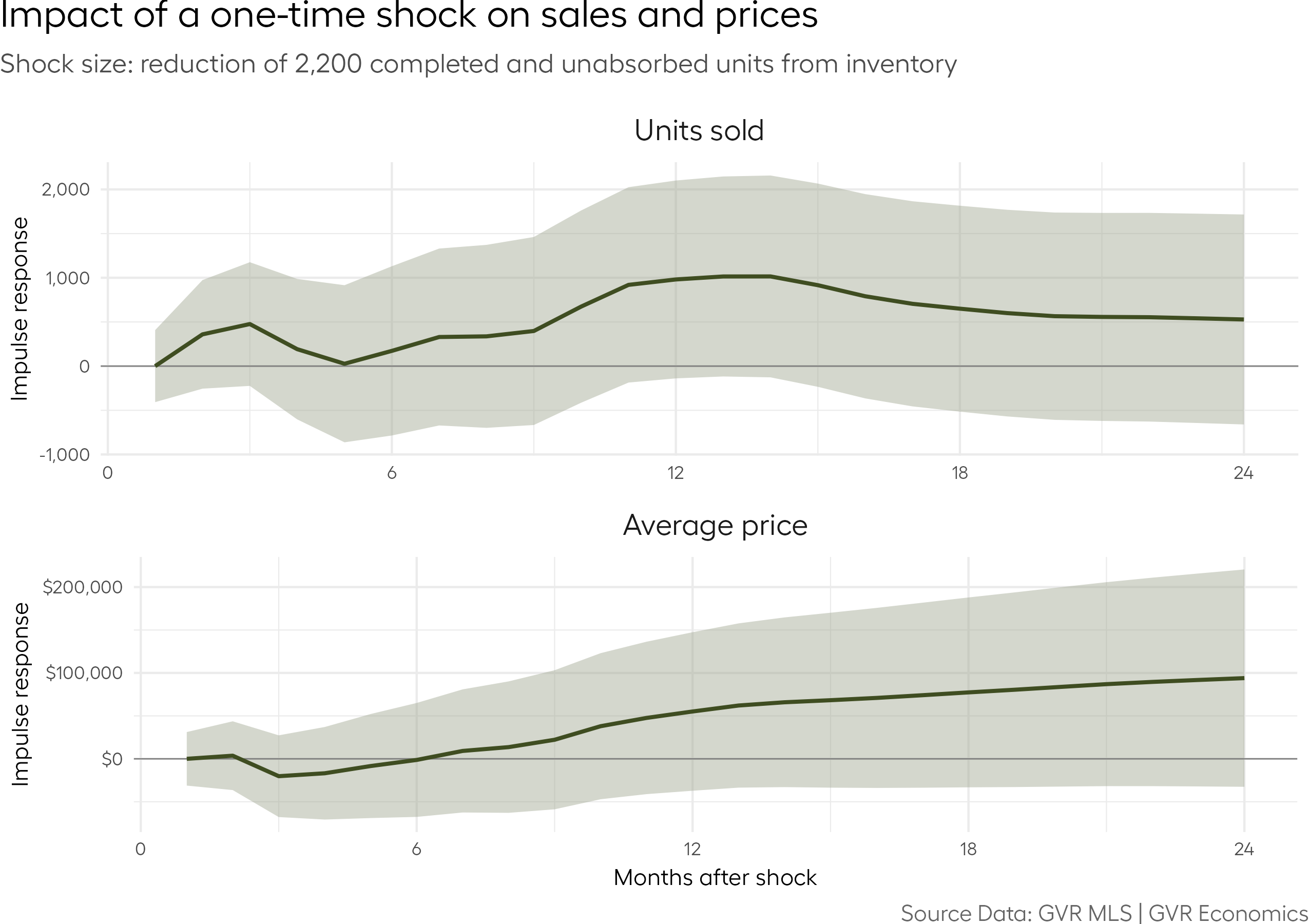
The first thing worth noting is that the error bands around the impulse response estimates are pretty wide, which is to be expected given the simplicity of the model we are working with.
But since the error bands extend below the zero line for both sales and prices, we can’t say with a great degree of confidence that either variable would move up with certainty. It’s plausible they could go down as well.
But if we take the point estimates at face value (point estimates = the solid lines, not the shaded error bands), it’s clear that this shock has the potential to have significant impact on sales and prices. (At least in the short run.)
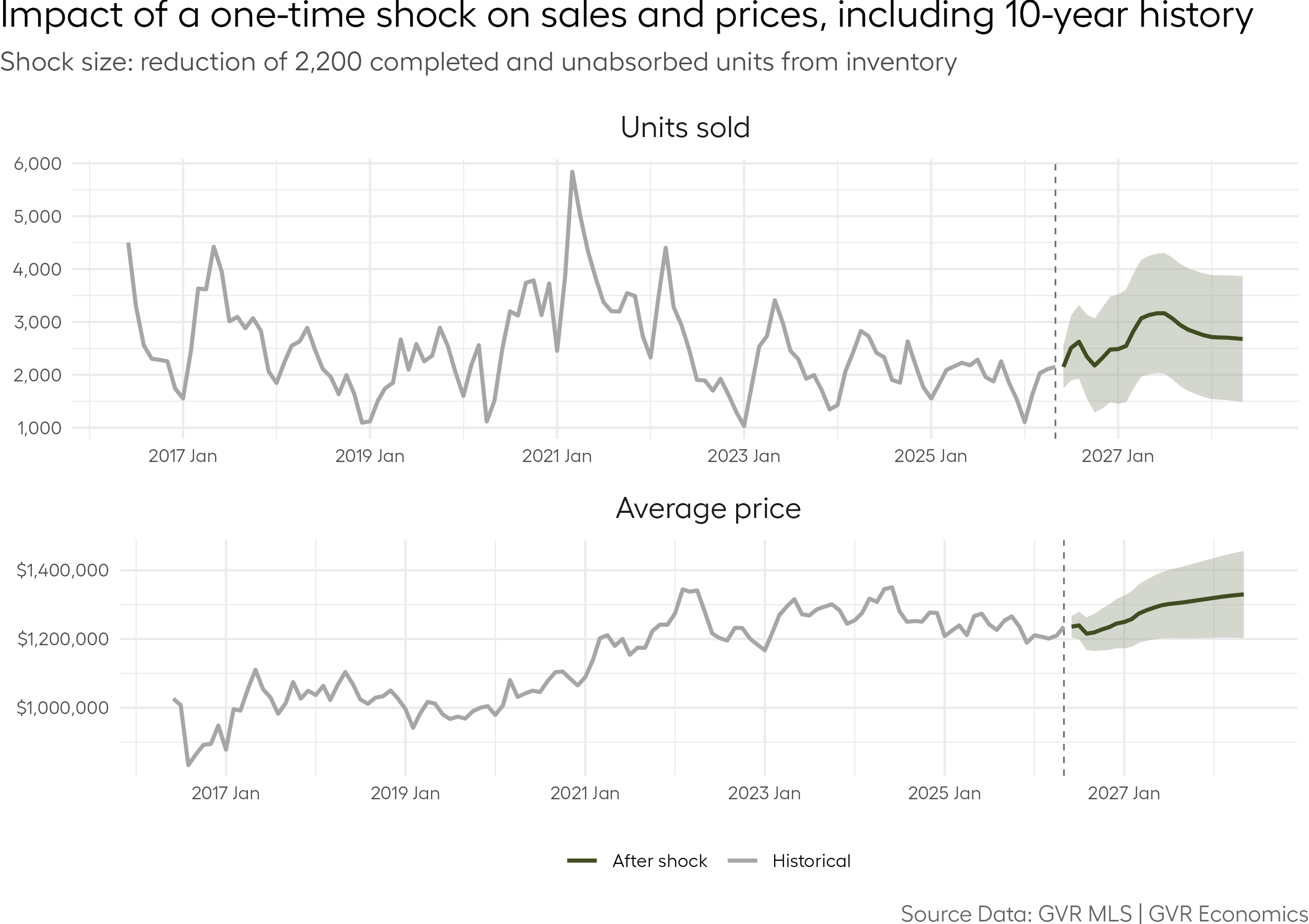
To add some historical context, here’s a plot of these shocks bolted on to a 10-year history of sales and prices:
Caveats
There are more than a few caveats to keep in mind.
As noted, this is a very trivial simple model. So there’s that.
But we also have to remain mindful that this kind of shock is a form of artificial demand. The government is buying up units and has no intention of keeping on buying once it hits its 2,200-unit quota.
That kind of demand isn’t really representative of what you’d expect in a free market filled with buyers willing to pay market prices and competing with each other for a fixed supply of units.
But our simple model here doesn’t understand that. It just thinks: “Demand shock! Inventory goes down!”.
There’s no easy way to introduce the concept of “artificial demand” into a model like this without getting into some hairy econometric territory. So we have to live with the limitations for now.
Final thoughts
As an economist, the thing about this that stands out is how interventions in market dynamics can have perverse effects that aren’t alaways immediately obvious.
I’m sure the feds have thought about the fact that a bulk purchase like this could stoke demand and actually raise prices in the long run, but they’re clearly evaluating the trade-offs and acting accordingly.
It’s hard to say whether the impact would unfold as our simple little model predicts, so I wouldn’t want to get too far ahead of things and call a boom in prices and sales.
With that said, it’s hard to deny that a bulk purchase of this magnitude would have at least some impact on the market’s long-run equilibrium.
We’ll maybe revisit this topic when more details come out about the plan. For now, we’ll leave it in the realm of armchair speculation.